
What's an IRA?
An IRA is a personal retirement account designed to help investors save for the future. These tax-advantaged accounts offer different tax benefits depending on the type of IRA. Read more below to learn about the 2 most common account types, traditional and Roth.
Why open an IRA?


Types of IRAs we offer
- Traditional IRA
- Rollover IRA
- Roth IRA
- SEP-IRA
- Custodial IRA
Traditional IRA
A Traditional IRA allows you to potentially reduce your current taxable income through tax-deductible contributions while allowing for tax-deferred investment growth, making it ideal for those seeking immediate tax benefits.
Benefits:
- Contributions may be tax-deductible
- Withdrawals taxed as ordinary income
- No income limitations
- Spousal IRA available for low/no-income spouse

Rollover IRA
You can roll over funds from a former employer's retirement plan—like a 401(k) or 403(b)—into a Vanguard Rollover IRA to maintain your savings' tax-advantaged status while gaining access to a broad range of investment options.
Benefits:
- Combine multiple retirement accounts in one place
- Preserve tax-advantaged growth with no taxes or penalties for a direct rollover2
- May offer more investment options and lower fees than a 401k

Roth IRA
A Roth IRA offers tax-free growth and tax-free withdrawals in retirement, making it an attractive option for those who expect to be in a higher tax bracket later or want to maximize their after-tax retirement income without required minimum distributions.
Benefits:
- Contributions are made with after-tax dollars and are not deductible
- Tax-free withdrawals after age 59½ with 5-year holding period1
- Income limitations apply
- Spousal IRA available for low/no-income spouse

SEP-IRA
A SEP-IRA (Simplified Employee Pension) is a retirement plan for anyone who is self-employed, owns a business, or earns freelance income. It offers tax-deductible contributions with generous contribution limits. Vanguard’s SEP-IRA is designed exclusively for self-employed individuals and business owners who don’t employ others.
Benefits:
- Contribute up to 25% of compensation up to the annual IRS limit
- Tax-deductible contributions lower taxable income
- Flexible contributions vary by business performance

Custodial IRA
A Minor or Custodial IRA allows children and teenagers with earned income to start building their retirement savings early, harnessing the power of compound growth over decades while learning valuable financial lessons.
Benefits:
- Contributions limited to earned income or IRA limit
- Available as Traditional or Roth IRA
- Managed by an adult, often a parent or guardian, until minor reaches age of majority

Traditional IRA
A Traditional IRA allows you to potentially reduce your current taxable income through tax-deductible contributions while allowing for tax-deferred investment growth, making it ideal for those seeking immediate tax benefits.
Benefits:
- Contributions may be tax-deductible
- Withdrawals taxed as ordinary income
- No income limitations
- Spousal IRA available for low/no-income spouse
Rollover IRA
You can roll over funds from a former employer's retirement plan—like a 401(k) or 403(b)—into a Vanguard Rollover IRA to maintain your savings' tax-advantaged status while gaining access to a broad range of investment options.
Benefits:
- Combine multiple retirement accounts in one place
- Preserve tax-advantaged growth with no taxes or penalties for a direct rollover2
- May offer more investment options and lower fees than a 401k
Roth IRA
A Roth IRA offers tax-free growth and tax-free withdrawals in retirement, making it an attractive option for those who expect to be in a higher tax bracket later or want to maximize their after-tax retirement income without required minimum distributions.
Benefits:
- Contributions are made with after-tax dollars and are not deductible
- Tax-free withdrawals after age 59½ with 5-year holding period1
- Income limitations apply
- Spousal IRA available for low/no-income spouse
SEP-IRA
A SEP-IRA (Simplified Employee Pension) is a retirement plan for anyone who is self-employed, owns a business, or earns freelance income. It offers tax-deductible contributions with generous contribution limits. Vanguard’s SEP-IRA is designed exclusively for self-employed individuals and business owners who don’t employ others.
Benefits:
- Contribute up to 25% of compensation up to the annual IRS limit
- Tax-deductible contributions lower taxable income
- Flexible contributions vary by business performance
Custodial IRA
A Minor or Custodial IRA allows children and teenagers with earned income to start building their retirement savings early, harnessing the power of compound growth over decades while learning valuable financial lessons.
Benefits:
- Contributions limited to earned income or IRA limit
- Available as Traditional or Roth IRA
- Managed by an adult, often a parent or guardian, until minor reaches age of majority

How your retirement savings could grow
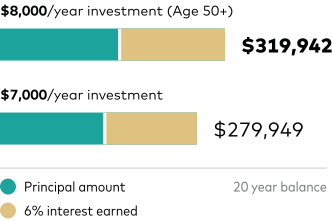
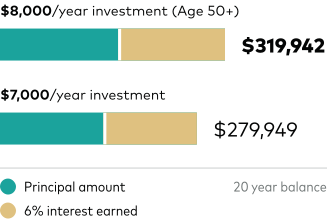
While the annual IRA contribution limit of $7,500 may not seem like much, you can stack up significant savings.


This hypothetical example does not represent the return on any particular investment and the rate is not guaranteed.
Pay less and keep more. The average Vanguard mutual fund expense ratio is
84%
than the industry average.3


At age 50, you qualify for a $1,100 IRA catch-up contribution—jumping your annual limit to $8,600—potentially increasing the power of compounding, which could mean greater savings for you over time.
This hypothetical example does not represent the return on any particular investment and the rate is not guaranteed.


Helpful resources

Investing on your own?
Check out key information you can use as you begin your successful DIY investing journey.

Looking for professional advice?
We offer expert help at the low cost we're known for.

Have a nonretirement savings goal?
We have a variety of accounts to select from. See which best fits your savings needs.

How to invest your IRA

IRA vs. 401(k)

Understanding 401(k) to IRA rollover rules
Frequently asked questions
There's no charge to open a Vanguard IRA. The fund or product you choose may have a minimum investment amount.
Minimum investments for Vanguard mutual funds can range from $3,000 to $50,000. Non-Vanguard fund minimums are subject to the respective fund companies' rules.
Vanguard ETFs® can be purchased for as little as $1. Non-Vanguard ETFs and products—like stocks, bonds, etc.—must be purchased at market price.
Traditional IRA contributions could help reduce your taxable income. Your deduction amount can vary depending on your modified adjusted gross income and whether you're covered by a retirement plan at work.
An IRA itself isn't an investment. It's a basket that holds your selected products—mutual funds, ETFs, stocks, bonds, etc. Your retirement portfolio's earnings depend on the investments you choose, how they perform in the market, and the interest they pay.
You can invest in mutual funds, ETFs, stocks, bonds, and more. You can even select mutual funds created specifically for retirement. Target Retirement Funds, for example, are broadly diversified mutual funds that come with a preset, professionally managed investment mix—so you can get a complete portfolio with just one fund.
Learn how to choose IRA investments
Explore Target Retirement Funds
If you have a retirement account, like a 401(k) or 403(b), with a former employer, consider rolling over that money into an employer-sponsored plan held at Vanguard or a Vanguard IRA. Keeping track of your portfolio can be easier when all your assets are consolidated in one place.
Yes. You can get the advice you need by using our robo-advisor or working with a financial advisor for ongoing portfolio guidance and access to exclusive tools.
1Withdrawals from a Roth IRA are tax-free if you're age 59½ or older and have held the account for at least 5 years; withdrawals taken prior to age 59½ or 5 years may be subject to ordinary income tax or a 10% federal penalty tax, or both. (A separate 5-year period applies for each conversion and begins on the first day of the year in which the conversion contribution is made.) The 5-year holding period for Roth IRAs starts on the earlier of: (1) the date you first contributed directly to the Roth IRA, (2) the date you rolled over a Roth 401(k) or Roth 403(b) to the Roth IRA, or (3) the date you converted a traditional IRA to the Roth IRA. If you're under age 59½ and you have one Roth IRA that holds proceeds from multiple conversions, you're required to keep track of the 5-year holding period for each conversion separately.
2There are important factors to consider when rolling over assets to an IRA. These factors include, but are not limited to, investment options in each type of account, fees and expenses, available services, potential withdrawal penalties, protection from creditors and legal judgments, required minimum distributions, and tax consequences of rolling over employer stock to an IRA.
3Vanguard average expense ratio: 0.07%. Industry average expense ratio: 0.44%. All averages are asset-weighted. Industry averages exclude Vanguard. Sources: Vanguard and Morningstar, Inc., as of December 31, 2025.
For more information about Vanguard mutual funds or Vanguard ETFs, obtain a mutual fund or an ETF prospectus or, if available, a summary prospectus. Investment objectives, risks, charges, expenses, and other important information are contained in the prospectus; read and consider it carefully before investing.
Vanguard ETF Shares are not redeemable with the issuing Fund other than in very large aggregations worth millions of dollars. Instead, investors must buy and sell Vanguard ETF Shares in the secondary market and hold those shares in a brokerage account. In doing so, the investor may incur brokerage commissions and may pay more than net asset value when buying and receive less than net asset value when selling.
Investments in target-date funds are subject to the risks of their underlying funds. The year in the fund name refers to the approximate year (the target date) when an investor in the fund would retire and leave the workforce. The fund will gradually shift its emphasis from more aggressive investments to more conservative ones based on its target date. An investment in target date funds is not guaranteed at any time, including on or after the target date.
When taking withdrawals from an IRA before age 59½, you may have to pay ordinary income tax plus a 10% federal penalty tax.
All investing is subject to risk, including the possible loss of the money you invest. There is no guarantee that any particular asset allocation or mix of funds will meet your investment objectives or provide you with a given level of income. Diversification does not ensure a profit or protect against a loss.
Vanguard Fiduciary Trust Company serves as the custodian of Vanguard IRAs.
Vanguard’s advice services are provided by Vanguard Advisers, Inc. (“VAI”), a registered investment advisor, or by Vanguard National Trust Company (“VNTC”), a federally chartered, limited-purpose trust company.
The services provided to clients will vary based upon the service selected, including management, fees, eligibility, and access to an advisor. Find VAI’s Form CRS and each program’s advisory brochure here for an overview.
VAI and VNTC are subsidiaries of The Vanguard Group, Inc., and affiliates of Vanguard Marketing Corporation. Neither VAI, VNTC, nor its affiliates guarantee profits or protection from losses.