Vanguard introduces 10 Target Maturity Corporate Bond ETFs—designed to mimic bonds to maturity while offering diversification, liquidity, and low costs.
Introducing Vanguard's new Target Maturity Corporate Bond ETF suite

Key points:
- 10 new Vanguard ETFs® that act like individual bonds: Vanguard's new suite of corporate bond target maturity ETFs ("TMEs" or "BondBuilder™ TMEs") mimics the experience of holding a bond to maturity by targeting specific time horizons and can be used for goals-based planning, liquidity management, and constructing bond ladders.
- Benefits typically reserved for separately managed accounts by using BondBuilder TMEs for bond laddering: BondBuilder TMEs can help you manage your portfolio with custom precision while the ETF structure has features you won't have by directly holding bonds: cost-efficient access, easier trade execution, and greater diversification.
- Low-cost investments designed for predictable cash-flow planning: Each TME holds a diverse set of investment-grade corporate bonds maturing in the TME's target year. The underlying bond holdings support monthly income, while diversification helps with predictability and expected return of principle at maturity. Estimated expense ratio: 0.08%.1
On March 26, 2026, Vanguard launched 10 corporate bond ETFs, which we refer to as our BondBuilder TME suite.
The BondBuilder TMEs combine the precision and predictability of individual bonds with the diversification, accessibility, and tradability of a traditional bond ETF. When combined, the TMEs may offer a compelling alternative to directly held bonds and separately managed accounts for goals-based planning, liquidity management, or building bond ladders. Like individual bonds, TMEs generally exhibit less volatility than traditional bond ETFs with a set duration because the duration of TMEs declines as they approach maturity.
Why should you consider TMEs?
The launch of the 10 TMEs means you have access to efficient, versatile tools for customizing your portfolio. You benefit from a product that's designed to provide predictable monthly income distributions over the life of the TME, return of principal when the TME matures, and daily liquidity to adjust your portfolio as needed.
TMEs can experience less volatility than a single bond since they're composed of a diverse portfolio of bonds, which lowers default risk and increases return potential.
Why investment-grade corporate bonds?
Strong credit quality and historically low default rates of investment-grade corporate bonds support the potential for regular monthly income.
This makes them well-suited for bond ladders when the goal is often to meet specific time horizons, liquidity needs, or future liabilities.
Given the goals-based purpose of bond-laddering strategies, an index approach using investment-grade corporate bonds can make more sense than an active strategy by reducing costs as a result of reduced portfolio turnover.
How TMEs work
Monthly distributions
Similar to traditional bond ETFs, TMEs distribute monthly income that reflects the TMEs' underlying bond coupon payments and other cash flow-driven events. Investors can elect to reinvest these dividends automatically or receive the distribution payments.


Defined maturity date when the product is designed to return principal
Each TME holds bonds that mature or are expected to be called during the fund's final year of life. Proceeds of bonds that have matured during the final year of the TME's life are reinvested in cash or cash equivalents. Once all bonds in the portfolio have matured, each TME liquidates and distributes a final payment that reflects the fund's net asset value (NAV).
Declining interest rate sensitivity
Similar to an individual bond, the average duration of a TME declines over the life of the fund, which reduces the interest rate risk of your investment as maturity approaches.
This results in lower volatility in TMEs compared with traditional bond ETFs which have a set duration and, unlike TMEs, no defined maturity.
Why choose Vanguard for TMEs?
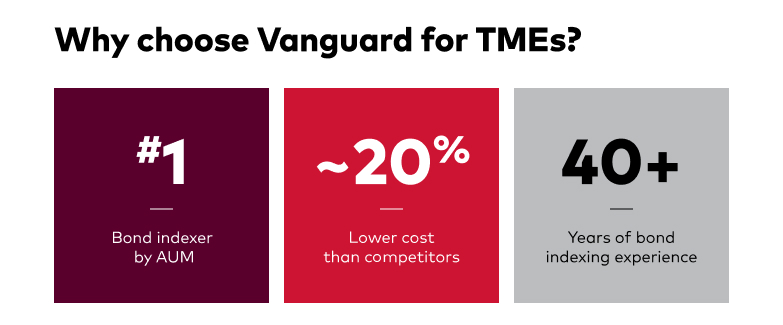

Note: The #1 bond indexing provider based on assets under management data from Morningstar, Inc., as of December 31, 2025. Lower-cost-than-competitors claim based on Vanguard analysis of Morningstar data as of February 28, 2026.
Source: Vanguard and Morningstar.
With an estimated expense ratio of 0.08%, the BondBuilder TMEs are anticipated to be priced 20% lower than competitor suites of products.2 This low-cost access, plus Vanguard's 40-plus years of indexing expertise and its global team of fixed income experts, are cornerstones of our institutional quality bond funds.3
BondBuilder TMEs
| BondBuilder ETF name | Ticker | Expense ratio |
|---|---|---|
| Vanguard Target Maturity 2027 Corporate Bond ETF | VBCA | 0.08% |
| Vanguard Target Maturity 2028 Corporate Bond ETF | VBCB | 0.08% |
| Vanguard Target Maturity 2029 Corporate Bond ETF | VBCC | 0.08% |
| Vanguard Target Maturity 2030 Corporate Bond ETF | VBCD | 0.08% |
| Vanguard Target Maturity 2031 Corporate Bond ETF | VBCE | 0.08% |
| Vanguard Target Maturity 2032 Corporate Bond ETF | VBCF | 0.08% |
| Vanguard Target Maturity 2033 Corporate Bond ETF | VBCG | 0.08% |
| Vanguard Target Maturity 2034 Corporate Bond ETF | VBCH | 0.08% |
| Vanguard Target Maturity 2035 Corporate Bond ETF | VBCI | 0.08% |
| Vanguard Target Maturity 2036 Corporate Bond ETF | VBCJ | 0.08% |
Note: Benchmarks for the BondBuilder TMEs are part of the ICE 20XX Maturity US Corporate Constrained Index series. The expense ratio information shown reflects estimated amounts for the current fiscal year.
Source: Vanguard.