Over the coming decade, we expect high-quality private equity funds to outperform public equity portfolios.
Private equity outlook: What matters for long-term investors

Successful stakes entail discipline, diversification, flexibility with liquidity, and rigorous manager selection.
Private market investments can play a meaningful role in well‑constructed portfolios by enhancing long‑term return potential and expanding diversification beyond public markets. Vanguard's private equity offering for Wealth Management reflects our disciplined approach to manager selection, diversification, cost consciousness, and risk awareness.
We invite you to explore this research, learn more about our offer, and stay tuned for additional insights on how private markets may fit into your long-term plan.
Highlights
- Private equity investments face several near-term challenges, but over the coming decade, we expect that high-quality managers with reasonable fees will deliver high-single-digit annualized returns, outperforming public equities.
- Investors should prioritize rigorous manager selection and diversification because of the high level of manager risk, partnering with firms that secure lower costs.
- Investors should also commit to a consistent private equity investment strategy and maintain flexibility with liquidity.
Private equity managers are navigating a challenging backdrop, with elevated borrowing costs and constrained exit opportunities. Secondary market volume—that is, the trading of fund interests—has risen. At the same time, discounts to net asset value have held steady, while fundraising has slowed amid the exit backlog. Despite this environment, our long-term outlook for high-quality private equity funds remains positive.
Dispersion of fund returns is likely to stay wide
Public equity returns have been strong, and private equity assets have grown significantly, but private equity funds in the top two quartiles of long-term performance have continued to deliver excess returns (Brown et al., 2024). While the asset-weighted return of buyout funds has underperformed a public index over the past few years, short-term stretches like this are not new (Rabinovich and Schweitzer, 2025). Despite the private equity industry's maturation, the dispersion of excess returns remains significantly wider than for public equity funds and is at an absolute level close to historical norms, underscoring the continued importance of high-quality manager selection.
High-quality manager selection remains critical given high PE fund dispersion

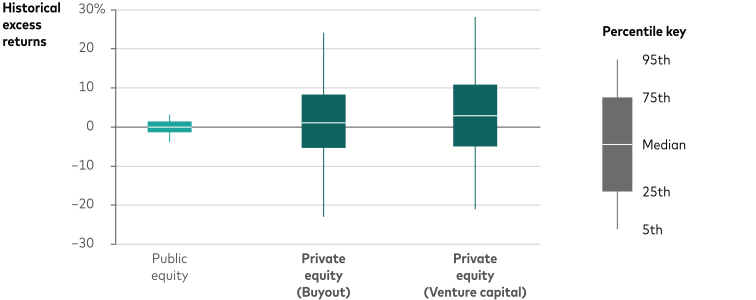

Notes: Analysis of public equity funds is based on their annual net-of-fee excess return over each fund's benchmark, using 10 years of global active fund performance data as of Dec. 31, 2024. Calculations use net-of-fee data for private equity funds from vintage year 1998 to 2024. Excess returns are annualized and represented by "Direct Alpha." Direct Alpha is an annualized measure of excess return that compares the performance of a private investment with the hypothetical return of a public market index, assuming an identical cash-flow pattern. Direct Alpha for buyout is computed against the Russell 3000 Index, and venture capital is computed against the Russell Microcap Index. For details on the methodology used to calculate Direct Alpha, see Gredil, Griffiths, and Stucke (2023). Past performance is not a guarantee of future results. The performance of an index is not an exact representation of any particular investment, as you cannot invest directly in an index.
Sources: Vanguard calculations, using data from Morningstar Inc. and MSCI.
Valuation spreads remain reasonable
Valuations remain elevated across private and public markets, but the spread continues to support the case for a private equity liquidity risk premium. In addition, secondary market volume for investors who demand liquidity continues to provide attractive opportunities for skilled managers to find high-quality assets at attractive prices.
Fees may be sticky without negotiating power
Fees directly affect investment returns, yet despite the tendency in other markets for fee percentages to decline as assets grow, private equity fund fees have remained relatively stable (Callan, 2024). Firms that negotiate lower management fees can boost net performance for investors.1
Valuations for private companies are attractive compared with public markets

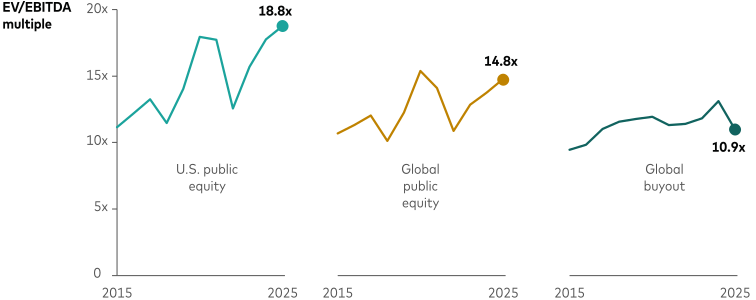

Notes: The global buyout EV/EBITDA multiple is computed as the equal-weighted average of the median global buyout multiples of enterprise value to earnings before interest, taxes, depreciation, and amortization, as reported by Preqin and PitchBook. While these databases cover distinct sets of deals, some overlap may exist. Averaging across both sources provides a more representative estimate of prevailing valuation levels. Global and U.S. public equity valuations are based on the MSCI ACWI Investable Market Index and the Standard & Poor's 500 Index, respectively.
Sources: Preqin, PitchBook, and FactSet data, as of September 30, 2025.
Earnings growth will be critical
Given stretched absolute valuations, future returns hinge on earnings growth rather than multiple expansion. With leverage less attractive in a higher-interest-rate environment, private equity managers are prioritizing organic growth, operational improvements, and strategic acquisitions for their portfolio companies. We expect reasonable corporate earnings growth of approximately 5% annually in the U.S. and about 4% globally over the next decade.2
Putting it all together: Forecast
Vanguard's public equity return outlook for the next decade, particularly in the U.S., is cautious, with a wide range of possible outcomes. In comparison, the net-of-fee forecast for higher-quality private equity funds remains appealing, although the range of possible outcomes is wider given the inherent illiquidity and active risk. If investors gauge the risk of private equity investing by the average volatility of quarterly private equity fund net asset values, they might believe that private equity is safer than the public markets. However, we believe that this measure is artificially low and understates true risk. Our estimates in the chart below suggest the volatility is broadly comparable to that of public equity markets, aligning with theoretical expectations.
Private equity is likely to outpace public markets


Notes: These return assumptions depend on current market conditions and may change over time. The PE return expectations are net of fund fees and assume zero manager alpha and a typical risk profile when a diversified program of funds is held. If an investor were able to identify and access high-quality managers with reasonable fees, a task that is challenging and carries significant uncertainty, that would shift the distribution to the right accordingly.
Sources: Vanguard calculations, using data from the MSCI-Burgiss Private Capital Universe sample and asset-return projections from the Vanguard Capital Markets Model (VCMM).
IMPORTANT: The projections and other information generated by the VCMM regarding the likelihood of various investment outcomes are hypothetical in nature, do not reflect actual investment results, and are not guarantees of future results. Distribution of return outcomes from the VCMM are derived from 10,000 simulations for each modeled asset class. Simulations are as of October 31, 2025. Results from the model may vary with each use and over time. For more information, please see the related notes at the end of this article.
Bottom line
Despite elevated levels of economic uncertainty, we remain positive on the long-term outlook for high-quality private equity funds. Our view is supported by historical performance, fair relative valuations, and reasonable earnings growth expectations.
Given the manager and liquidity risks inherent to private equity investing, discipline, diversification, flexibility with liquidity, and rigorous manager selection remain critical. Considering there is no guarantee of outperformance, the expected return premium must be high enough to compensate for these risks (Aliaga-Díaz et al., 2022). These factors make private equity unsuitable for some investors. For those who choose to pursue private equity, diversifying across managers, strategies, vintages, and regions, sticking to a consistent private equity commitment strategy, and partnering with a firm that can negotiate attractive fees can help improve the likelihood of achieving investment success.3,4
Want to learn more about Wealth Management?
Authors
Bill Stout
Vanguard Head of Private Markets Strategy
Ankul Daga, CFA
Vanguard Senior Manager and Investment Strategist
Douglas M. Grim, CFA
Vanguard Senior Researcher, Investment Implementation
Rich Powers
Vanguard Head of Private Equity Product Management
Note: CFA® is a registered trademark owned by CFA Institute.