Learn the difference between a mutual fund and ETF by comparing ETF vs. mutual fund minimums, pricing, risk, management, and costs to decide what’s best for you.
ETFs vs. mutual funds: A comparison
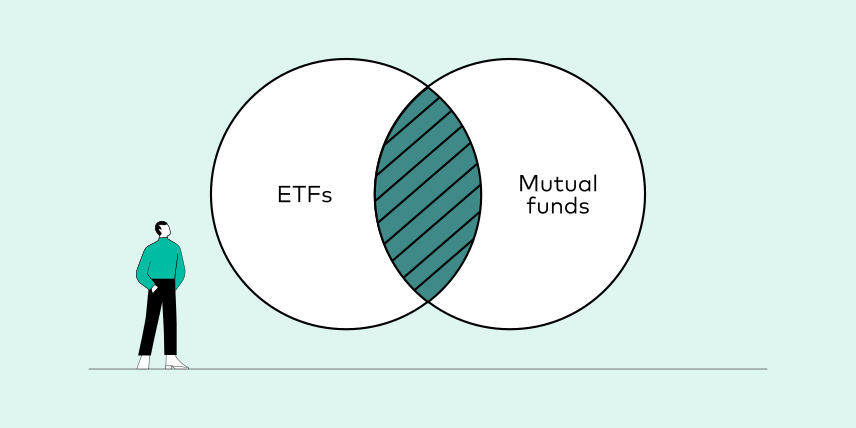
You may be surprised by how similar ETFs (exchange-traded funds) and mutual funds are. Just a few key differences set them apart.
- Both ETFs and mutual funds are professionally managed investments that are typically less risky than individual stocks or bonds.
- ETFs are traded during market hours, which is similar to stocks. They have lower minimum investment amounts and tend to be more tax-efficient than mutual funds.
- Initial investments in mutual funds aren’t based on share price, but rather on a flat dollar amount. Funds are priced and traded only once per day, after the market closes.
- When researching characteristics such as performance and risk, you should compare specific funds, and not “all ETFs” versus “all mutual funds.”
Similarities between mutual funds and ETFs
The biggest similarity between ETFs and mutual funds is that they both represent professionally managed collections (or “baskets”) of individual stocks or bonds. But that’s just the beginning—they also share the 4 additional traits outlined below.
Both are less risky than individual stocks and bonds
ETFs and mutual funds spread your investments across a broad range of asset classes, sectors, and regions to bring you built-in diversification—a strategy intended to help lower your chances of losing money.
Here’s how it works. One fund could include tens, hundreds, or even thousands of individual stocks or bonds to help reduce the impact of a single security’s poor performance. For example, if one stock or bond in the fund is doing poorly, there’s a chance that another is doing well. This strategy can help stabilize your portfolio by potentially offsetting losses in one area with gains in another.
Additionally, ETFs and mutual funds often have professional managers who actively monitor and adjust the portfolio to minimize risk and maximize returns. This professional oversight can further reduce risk by ensuring the portfolio is aligned with the investment objectives and is adjusted appropriately in response to market conditions.
Both offer a wide variety of investment options
ETFs and mutual funds both give you access to a wide variety of U.S. and international stocks and bonds. The funds either track a benchmark index like the S&P 500 or are actively managed. You can invest:
Broadly: For example, with a total market fund that invests in U.S. or international stocks or bonds. Total market funds typically replicate the performance of a broad market index and provide exposure to the entire bond or stock market, or a representative sample of the bonds or stocks in that index, offering diversification across various sectors and companies.
Narrowly: For example, a high-dividend stock fund or a sector fund that invests in a specific industry, such as technology, health care, energy, or real estate. Though sector funds have the potential to grow, you should be equally prepared for higher risk and volatility due to the lack of diversification across different sectors.
Anywhere in between. It all depends on your personal goals and investing style. At Vanguard, we offer more than 100 ETFs and more than 250 mutual funds.
There are funds for every kind of investor.
Both are overseen by professional portfolio managers
ETFs and mutual funds are managed by experts. Those experts choose and monitor the stocks or bonds the funds invest in, saving you time and effort.
Although most ETFs—and many mutual funds—are index funds, the portfolio managers are still there to make sure the funds don’t stray from their target indexes.
Here’s how a portfolio manager is different from a personal financial advisor:
- The manager of an index fund is responsible for managing a fund that tracks a specific index. Their role is to help maintain the fund’s alignment with the index.
- The manager of an actively managed fund uses their expertise to try to beat the market—or, more specifically, to beat the fund’s benchmark.
- A financial advisor provides tailored advice taking into consideration your goals, risk tolerance, and personal circumstances. They offer guidance on a wide range of financial matters, including strategies to help lower your taxes, retirement planning, portfolio oversight, and more.
Both are commission-free at Vanguard
All ETFs and Vanguard mutual funds can be bought and sold online commission-free in your Vanguard Brokerage Account.1
Compare ETFs and mutual funds to other investment products.
What’s the difference between mutual funds and ETFs?
| ETFs | Mutual funds | |
What’s the minimum investment? |
If you prefer lower investment minimums, an ETF might be more suitable for you. You can buy a Vanguard ETF® for as little as $1. Non-Vanguard ETFs can be purchased for as little as the cost of one share. |
Mutual fund minimum initial investments aren’t based on the fund’s share price. Instead, they’re a flat dollar amount. Most Vanguard mutual funds have a $3,000 minimum.2 That would buy you 30 shares of a hypothetical fund with a net asset value (NAV) of $100 per share. |
How are they traded? |
ETFs trade throughout the trading day at market prices. This provides real-time pricing and the ability to execute trades quickly. The price you pay or receive can change based on exactly what time you place your order. ETFs not only provide real-time pricing, but also let you use more sophisticated order types that give you the most control over your price. |
Mutual funds are priced at the end of the trading day and bought or sold based on their NAV, which is calculated after the market closes, typically around 4 p.m., Eastern time. Regardless of what time of day you place your order, you’ll get the same price as everyone else who bought and sold that day (before market close). That price is calculated based on the closing prices of every security owned by the fund. |
Can I make recurring investments? |
You can set up recurring investments (purchases) into your Vanguard ETF positions. |
You can set up recurring investments and withdrawals into and out of mutual funds based on your preferences.
|
What's the tax efficiency of ETFs vs. mutual funds? |
Because index mutual funds and ETFs generally trade less frequently, they tend to be more tax-efficient and have lower expense ratios than actively managed funds—which could mean lower costs for you. Compare index funds vs. actively managed funds to learn more about their differences. When it comes to ETF tax efficiency, these funds may have an additional tax benefit because of the way they trade. When ETF shares are sold, they’re exchanged between buyers and sellers on the market as opposed to the fund company. This means the fund itself usually isn’t involved in the transaction and doesn’t have to sell any securities, potentially triggering capital gains.
|
|
Are you looking to invest in index funds? |
Most ETFs are index funds (sometimes referred to as “passive” investments), including our lineup of more than 90 Vanguard index ETFs. | We also offer more than 130 Vanguard index mutual funds. |
ETFs
If you prefer lower investment minimums, an ETF might be more suitable for you.
You can buy a Vanguard ETF® for as little as $1.
Non-Vanguard ETFs can be purchased for as little as the cost of one share.
Check current prices for all Vanguard ETFs
Mutual funds
Mutual fund minimum initial investments aren’t based on the fund’s share price. Instead, they’re a flat dollar amount.
Most Vanguard mutual funds have a $3,000 minimum.2 That would buy you 30 shares of a hypothetical fund with a net asset value (NAV) of $100 per share.
ETFs
ETFs trade throughout the trading day at market prices. This provides real-time pricing and the ability to execute trades quickly. The price you pay or receive can change based on exactly what time you place your order.
ETFs not only provide real-time pricing, but also let you use more sophisticated order types that give you the most control over your price.
Mutual funds
Mutual funds are priced at the end of the trading day and bought or sold based on their NAV, which is calculated after the market closes, typically around 4 p.m., Eastern time.
Regardless of what time of day you place your order, you’ll get the same price as everyone else who bought and sold that day (before market close). That price is calculated based on the closing prices of every security owned by the fund.
ETFs
You can set up recurring investments (purchases) into your Vanguard ETF positions.
Mutual funds
You can set up recurring investments and withdrawals into and out of mutual funds based on your preferences.
ETFs & Mutual funds
Because index mutual funds and ETFs generally trade less frequently, they tend to be more tax-efficient and have lower expense ratios than actively managed funds—which could mean lower costs for you.
Compare index funds vs. actively managed funds to learn more about their differences.
When it comes to ETF tax efficiency, these funds may have an additional tax benefit because of the way they trade. When ETF shares are sold, they’re exchanged between buyers and sellers on the market as opposed to the fund company. This means the fund itself usually isn’t involved in the transaction and doesn’t have to sell any securities, potentially triggering capital gains.
ETFs
Most ETFs are index funds (sometimes referred to as “passive” investments), including our lineup of more than 90 Vanguard index ETFs.
Mutual funds
You can set up recurring investments and withdrawals into and out of mutual funds based on your preferences.
Unsure how to get started investing? We’re here to help.
ETF or mutual fund: Which is better for you?
Should I invest in mutual funds or ETFs? The choice depends on several factors. ETFs offer greater flexibility and trading control, as they can be bought and sold throughout the trading day like stocks. They also tend to be more tax-efficient due to the way they trade. Mutual funds, on the other hand, may offer a longer history, which can help you evaluate performance.
When you’re researching funds, it’s important to consider the fund’s expense ratio, trading commissions, and your target asset allocation—the combination of stocks, bonds, and cash you’re aiming to hold in your portfolio.
Our average expense ratio across our mutual funds and ETFs is 84% lower than the industry average.3 Plus there are no trading commissions when you buy and sell Vanguard mutual funds or ETFs online.4
Vanguard ETFs®
Our ETFs combine the diversification of mutual funds with real-time pricing—all with an investment minimum of just $1.
Ready to choose which ETFs you want to invest in?
Vanguard mutual funds
Vanguard has both index mutual funds and actively managed mutual funds.
Ready to choose which mutual funds you want to invest in?
Vanguard asset allocation tools
Take our investor questionnaire to find the right balance of stocks and bonds for your portfolio based on your goals and risk tolerance. You can also view how 9 model portfolios have performed in the past.
TRAITS WE HAVEN’T COMPARED YET
What about comparing ETFs versus mutual funds when it comes to performance? Risk? Expense ratios? Taxes?
Comparing these and other characteristics makes good investing sense. But unfortunately, it’s not as easy as categorically comparing “all ETFs” to “all mutual funds.”
For example, if you compare a stock ETF with a bond mutual fund, the ETF-vs.-mutual-fund comparison isn’t as important. What matters is that each invests in something completely different and, therefore, behaves differently.
Instead, compare 1 specific fund with another.